Our holistic approach focuses on the three critical elements; people, process, and technology. This allows us to better understand, analyze, and assess your business and its challenges.
Dedicating time and resources to understand your business and organization as a whole is key to formulate solutions that best fit your needs.
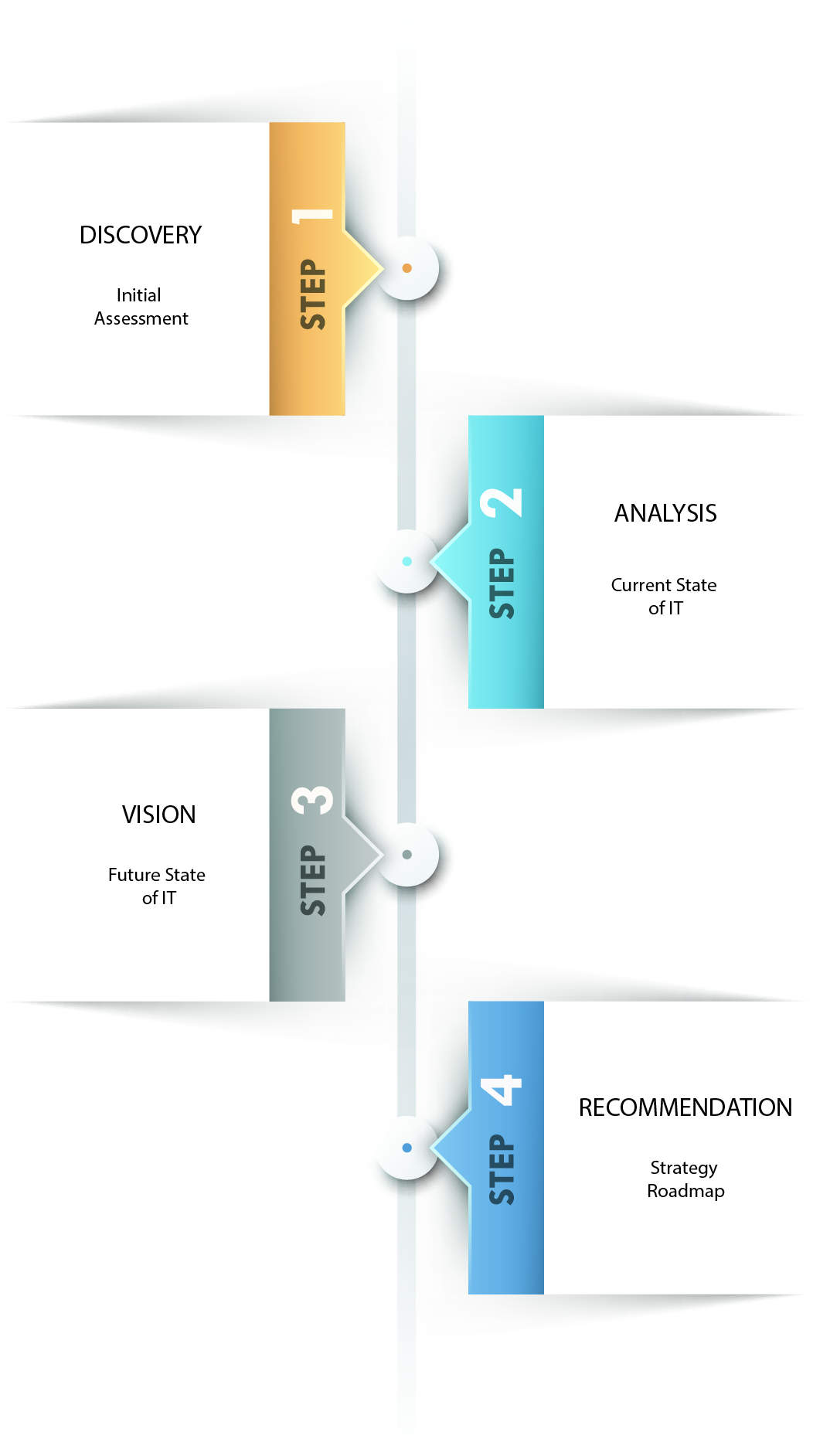
Our process starts by performing an initial assessment to understand your organization and uncover your challenges. We then analyze the data to develop a comprehensive report with findings, and recommendations. We typically go through the following phases.
Undertaken with our experienced professional, this step involves understanding of your business, mission, vision, strategy, challenges, and your desired outcome. It is critical for our team to have a solid understanding of your requirements so that we can set the concrete for the foundation of the solution for your organization.
Here we conduct an assessment of the current IT environment, including the organization’s infrastructure resources, IT assets, and documentation. The status and health of the current IT portfolio is assessed combined with user surveys and interviews. This allows us to prioritize systems that require replacement or upgrades. Using metrics, we also benchmark IT spending and staffing levels, the use of outsourcing services.
At this stage we begin to envision a future state where technology, people, and processes are aligned with the business strategy. This stage can include meeting sessions and workshops where our consultants discuss enabling and innovative technologies that your organization should consider for adoption. Finally, a gap analysis will be conducted to show the deficiencies between current and future state of IT.
At this stage we present the strategic roadmap that reveals where you are going and how you’ll get there. The final deliverable for the enterprise defines the desired future state, IT initiatives, and the priorities for implementation. The IT initiatives can include new systems, IT infrastructure improvements, IT organizational changes or restructuring, process improvements, governance structures, and risk management programs.